
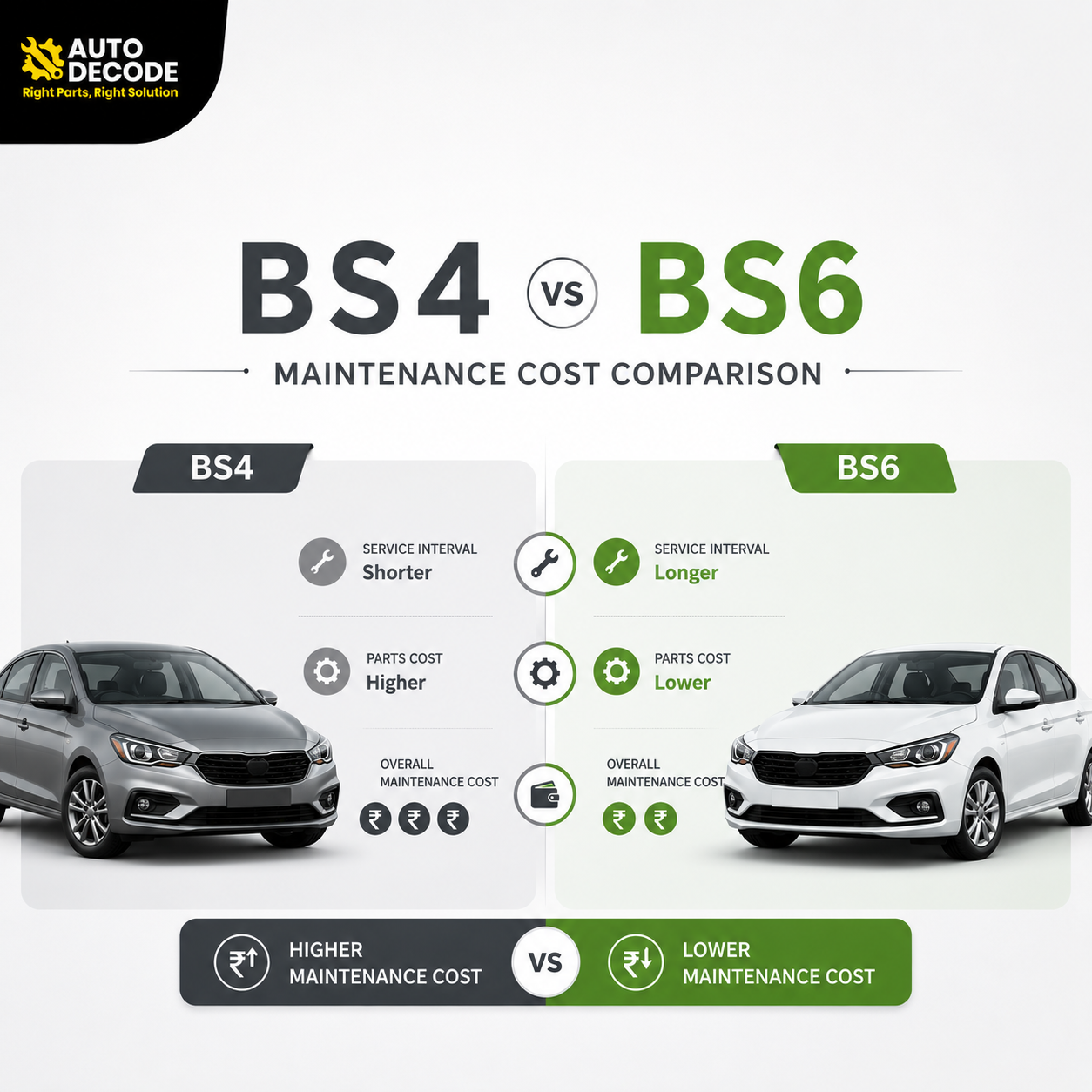
Most Indian car buyers know that BS6 cars are cleaner and more modern than BS4. What fewer people understand is that BS6 also quietly changed the cost of keeping a car running properly.
This is not about fuel cost or EMIs. It is about service cost, spare parts, engine oil grade, AdBlue top-ups, and what happens when you skip or cut corners on BS6-specific maintenance requirements.
If you own a BS6 car or are planning to buy one, this article will help you understand exactly where your maintenance costs may be higher, where they stay the same, and what mistakes to avoid.
Quick Answer
Yes, BS6 cars generally cost slightly more to maintain than BS4 cars, especially diesels. The main cost additions are stricter engine oil requirements, AdBlue/DEF top-ups for diesel vehicles, and the addition of emission-control components such as DPFs and GPFs that require proper maintenance. However, if you use the correct oil grade, the right fuel, and genuine or trusted-brand parts, the cost difference is manageable. The bigger risk is cutting corners, which can cause expensive damage to emission control systems that BS4 vehicles simply did not have.
What Changed from BS4 to BS6 That Affects Maintenance
BS6 (Bharat Stage 6) emission norms came into effect in India in April 2020. The standards align broadly with Euro 6 norms. To meet stricter limits on particulate matter (PM), nitrogen oxides (NOx), and hydrocarbons, manufacturers had to make significant engine and exhaust system changes.
These changes are what affect your maintenance cost:
For petrol BS6 cars:
- Gasoline Particulate Filter (GPF) added to many models
- More precise fuel injection systems
- More sensitive oxygen sensors and catalytic converters
- Stricter engine oil requirements to protect emission components
For diesel BS6 cars:
- Diesel Particulate Filter (DPF) added
- Selective Catalytic Reduction (SCR) system — requires AdBlue/DEF fluid
- Diesel Oxidation Catalyst (DOC)
- EGR (Exhaust Gas Recirculation) — more refined than BS4
- More sensitive fuel system requiring cleaner, higher-quality diesel
Understanding these additions is the first step to understanding where your service costs change.
Where BS6 Maintenance Costs More — and Why
1. Engine Oil Grade and Quality
This is the most universal change affecting all BS6 cars — petrol and diesel.
BS6 engines typically require engine oils with:
- Lower viscosity grades such as 0W-20 or 5W-30 (compared to the 15W-40 that was common in many BS4 vehicles)
- API SN Plus, SP, or equivalent rating, or ACEA C-series ratings for diesels
- Low SAPS (Low Sulphated Ash, Phosphorus, and Sulphur) formulations — especially for diesel vehicles with DPF
Why does this matter for cost?
Low viscosity, low SAPS, modern-specification oils cost more than conventional 15W-40 oils. A quality 0W-20 or 5W-30 oil that meets BS6 engine requirements will typically cost more per litre than a basic 15W-40 used in older BS4 vehicles.
What happens if you use the wrong oil in a BS6 engine?
Using a high SAPS or wrong-grade oil in a BS6 engine — particularly a diesel with DPF — can accelerate DPF clogging, shorten DPF life, and increase the risk of costly emission system damage. This is not a small risk. DPF replacement or cleaning is significantly more expensive than the cost difference between oil grades.
Always use the engine oil grade and specification recommended in your owner's manual. Do not let any workshop substitute a cheaper or incompatible oil to save money.
2. AdBlue / DEF — Diesel BS6 Cars Only
AdBlue (also called DEF — Diesel Exhaust Fluid) is a urea-based solution used in the SCR system of BS6 diesel vehicles to reduce NOx emissions.
BS6 diesel cars — including popular models like Hyundai Creta diesel, Kia Seltos diesel, Tata Safari diesel, MG Hector diesel, and others — have an AdBlue tank that needs periodic top-up.
How often does AdBlue need to be topped up?
Consumption varies by vehicle, engine, and driving conditions. In Indian stop-and-go city traffic, consumption can be higher. Many vehicles consume approximately 1 litre of AdBlue per 1,000 km, though this varies by model.
Your dashboard will warn you when AdBlue is low. If the tank runs empty, most BS6 diesel vehicles will either refuse to start or go into a restricted performance mode — by design, to ensure emission compliance.
What does AdBlue cost in India?
AdBlue is available from authorised dealerships, automotive parts stores, and some petrol stations. Prices vary. Always use genuine or OEM-specified AdBlue — do not dilute it or use water as a substitute. AdBlue is a precise formulation (32.5% urea, 67.5% deionised water). Using the wrong fluid can damage the SCR system, which is expensive to repair.
This is a new recurring cost that BS4 diesel owners never had.
3. DPF (Diesel Particulate Filter) and GPF (Gasoline Particulate Filter)
The DPF traps soot particles from diesel combustion. Over time, it fills up and must regenerate — either passively (during highway driving at sustained speeds) or actively (via a forced regeneration cycle managed by the ECU).
Why Indian driving conditions make DPF maintenance critical:
- Stop-and-go city traffic in Delhi, Mumbai, Bengaluru, and other cities does not allow passive DPF regeneration to complete properly.
- Short trips where the engine does not reach full operating temperature increase soot accumulation.
- Poor-quality diesel, even BS6 fuel from some outlets, can affect DPF regeneration efficiency.
If regeneration fails repeatedly, the DPF can become blocked. A blocked DPF requires either a professional forced regeneration service or, in severe cases, replacement — which can be very expensive.
What should you do?
- Allow the DPF regeneration to complete when the dashboard warning appears — do not switch off the engine mid-cycle.
- Take occasional highway runs if you primarily drive in city traffic. This helps passive regeneration.
- Use the correct engine oil grade (low SAPS) to reduce ash accumulation in the DPF.
- Service the vehicle on time and do not skip oil changes.
For petrol BS6 cars with GPF, the maintenance requirement is less severe than DPF, but the same logic applies — correct oil, correct service intervals, and not ignoring warning lights.
4. Fuel Quality Sensitivity
BS6 engines — both petrol and diesel — are more sensitive to fuel quality than their BS4 counterparts.
BS6 petrol requires fuel with lower sulphur content (10 ppm vs 50 ppm in BS4). BS6 diesel similarly requires ultra-low sulphur diesel (ULSD).
In India, BS6 fuel is mandated across the country. However, fuel quality can still vary between pumps, cities, and supply chains. Contaminated or adulterated fuel is a real concern in certain regions.
For BS6 diesel vehicles in particular, poor fuel quality can:
- Accelerate DPF clogging
- Damage common rail fuel injectors, which are precision components
- Affect the emission control system performance
- Trigger warning lights and fault codes
Fuel filter replacement on schedule is even more important in BS6 diesels than in BS4 diesels. Always buy fuel from reputable outlets and do not skip fuel filter changes to save money.
5. Sensors, Actuators, and Emission Components
BS6 vehicles have more sensors than BS4 — including additional oxygen sensors (upstream and downstream of the catalytic converter), NOx sensors in diesel vehicles, particulate matter sensors, and pressure sensors for DPF/GPF monitoring.
These sensors are important for:
- Monitoring emission system performance
- Triggering regeneration cycles
- Detecting faults and alerting the driver
Sensor replacement costs more than on basic BS4 vehicles. Genuine or equivalent-quality sensors are important — cheap unbranded sensors can give false readings, trigger unnecessary warning lights, or fail prematurely.
This is an area where the spurious parts market is growing as BS6 cars age. At Auto Decode, we consistently advise that emission system components — sensors, catalytic converters, DPF, and SCR components — should only be replaced with genuine OEM parts or trusted aftermarket brands with verified fitment.
Where BS6 Maintenance Cost Is Similar to BS4
Not everything costs more on a BS6 car. Many routine maintenance items are broadly similar:
- Air filter: Same replacement logic as BS4. Dusty Indian conditions still shorten filter life. Cost varies by vehicle model and filter brand.
- Cabin filter: No significant change from BS4.
- Spark plugs (petrol): BS6 petrol cars generally use iridium or platinum plugs with longer replacement intervals than BS4 long-life plugs. The plug itself may cost more, but the interval is longer.
- Brake pads and discs: No change related to BS6.
- Tyres: No change related to BS6.
- Battery: No significant BS6-specific difference for non-hybrid vehicles.
- Coolant: Similar requirements, though BS6 engines generally run tighter tolerances, making coolant condition more important.
- Suspension parts: No BS6-specific difference.
BS4 vs BS6 Maintenance Cost Comparison
| Maintenance Item | BS4 | BS6 | Cost Impact |
|---|---|---|---|
| Engine oil grade | 15W-40 common | 0W-20, 5W-30 typically required | Moderate increase |
| Oil specification | API SJ/SL common | API SP / ACEA C-series required | Moderate increase |
| AdBlue / DEF | Not required | Required (diesel only) | New recurring cost |
| DPF maintenance | Not applicable | Required (diesel) | New cost if neglected |
| GPF maintenance | Not applicable | Required (some petrol) | Low if maintained correctly |
| Fuel filter | Standard interval | Same or slightly tighter | Minimal |
| Air filter | Standard | Standard | No change |
| Spark plugs | Standard/long-life | Typically iridium / longer interval | Higher per plug, but longer life |
| Emission sensors | Basic | More sensors, more complex | Higher if replacement is needed |
| Catalytic converter | Standard | More complex / costlier | Higher if replacement is needed |
| Brake/suspension | Standard | Standard | No change |
Note: Costs vary by vehicle model, city, seller, labour, and part brand. The table reflects general trends, not fixed prices.
Common Mistakes BS6 Car Owners Make
Using the wrong engine oil grade.
Many local workshops still default to 15W-40 for all vehicles. For a BS6 engine, this can accelerate DPF clogging and cause long-term damage. Always specify the oil grade from your owner's manual.
Ignoring AdBlue low-level warnings.
Running AdBlue dry does not just trigger a warning — many BS6 diesels will not restart or will go into limp mode. Top up promptly and use only the correct specification fluid.
Switch off the engine during DPF regeneration.
If you see a DPF regeneration warning and switch off the engine before it completes, soot accumulates faster. Allow the process to complete — it typically takes 20–30 minutes of driving at higher engine loads.
Buying cheap or unbranded BS6-compatible parts.
The market for BS6 spare parts — especially sensors, filters, and catalytic converters — is growing, and so is the market for duplicates. Cheap sensors or wrong-spec filters can affect emission system performance and trigger expensive problems.
Assuming BS4 and BS6 parts are interchangeable.
They are not, for most emission-related components. Part numbers changed. Fitment must be confirmed using the vehicle model year, engine code, and OEM part number.
Skipping highway runs for city-only diesel driving.
DPF requires regeneration. If you only drive short distances in the city, take occasional longer drives to allow the DPF to clean itself naturally.
Auto Decode Expert Advice
BS6 maintenance does cost slightly more than BS4 — but the cost difference is predictable and manageable when you follow the manufacturer's recommendations.
The expensive problems come from cutting corners: wrong oil grade, skipped AdBlue top-ups, ignored DPF warnings, and cheap parts entering a more sensitive emission system.
At Auto Decode, we recommend:
- Always carry your owner's manual and know the correct oil grade, oil specification, and AdBlue specification for your vehicle.
- Never allow a workshop to substitute a cheaper oil without confirming it meets the required BS6 specification.
- Keep AdBlue topped up before the warning light appears — do not wait for it to go empty.
- If you drive mainly in city traffic with a BS6 diesel, take one longer drive per month to allow DPF regeneration.
- For emission-related spare parts, only buy OEM or trusted brand parts with confirmed fitment — this is not the place to save money with unknown aftermarket options.
- Confirm part numbers for any BS6-specific component before buying. BS4 and BS6 versions of the same car often have different part numbers for filters, sensors, and exhaust components.
The goal is not to avoid buying a BS6 car. The goal is to own it correctly.
Conclusion
BS6 cars are cleaner, more refined, and in many ways better engineered than their BS4 predecessors. But they come with specific maintenance requirements — especially around engine oil grade, AdBlue, DPF, and emission sensors — that BS4 vehicles did not have.
The BS4 vs BS6 maintenance cost difference is real but manageable. The real cost risk is not the slightly more expensive oil or the AdBlue top-up. It is the expensive repair that follows when these requirements are ignored, skipped, or substituted with the wrong products.
For Indian car owners who follow the correct maintenance schedule, use the right products, and buy genuine or verified spare parts, BS6 ownership is reliable. The cars are built to last — as long as you maintain them the way the manufacturer intended.
4. FAQ Section
Does a BS6 car cost more to maintain than a BS4 car?
Yes, slightly. The main additional costs for BS6 are engine oil grade (typically a more expensive low-viscosity, low-SAPS specification), AdBlue top-ups for diesel vehicles, and potential DPF or GPF maintenance. For petrol BS6 cars, the cost difference is smaller. For diesel BS6 cars, AdBlue and DPF care are the key additions.
What is AdBlue, and how often do I need to refill it?
AdBlue is a urea-based fluid used in the SCR system of BS6 diesel cars to reduce nitrogen oxide emissions. Consumption depends on the vehicle and driving conditions. A rough estimate is approximately 1 litre per 1,000 km, though this varies. Your dashboard will warn you when the level is low. Always use the correct specification AdBlue — do not dilute it or substitute it.
Can I use 15W-40 engine oil in my BS6 car?
Not unless your owner's manual specifies it. Most BS6 engines require 0W-20 or 5W-30 with modern API SP or ACEA C-series specification. Using a high-viscosity or high-SAPS oil in a BS6 engine — especially a diesel with DPF — can accelerate DPF clogging and cause damage over time. Always verify the correct grade for your specific vehicle.
What is a DPF, and how much does it cost to replace in India?
DPF stands for Diesel Particulate Filter. It traps soot from diesel exhaust and periodically regenerates to clean itself. If the DPF becomes blocked due to wrong oil, city-only driving, or ignored warnings, it may need professional regeneration or, in severe cases, replacement. DPF replacement is one of the more expensive repairs on a BS6 diesel car. Prevention through correct oil, timely servicing, and allowing regeneration to complete is far cheaper than replacement.
Are BS4 and BS6 spare parts interchangeable?
No, not for emission-related components. Many BS6 engines have different filters, sensors, catalytic converters, and exhaust components compared to their BS4 equivalents. Always confirm part numbers using the vehicle model year, engine code, and OEM catalogue before buying.
Does BS6 fuel cost more than BS4 fuel?
The pump price of BS6 petrol and diesel is the same as BS4 — consumers do not pay a premium at the pump based on emission grade. However, BS6 fuel quality is standardised at 10 ppm sulphur content, which is better for engine and emission system health.
Is it more expensive to insure or service a BS6 car than a BS4 car?
Insurance costs are not directly determined by the BS emission standard — they depend on the car's ex-showroom price, variant, and city. Service costs at authorised dealerships for BS6 cars may be slightly higher than BS4 due to more complex emission systems, longer inspection requirements, and more expensive specified fluids. Independent workshops familiar with BS6 requirements can be a practical alternative if they use the correct materials.
Call-to-Action
Need help selecting the right service kit, engine oil, filter, spark plug, tyre, or spare part for your vehicle?
Contact Auto Decode and we'll help you find the correct fitment and maintenance solution for your car.
📲 WhatsApp us: wa.me/917906442130